
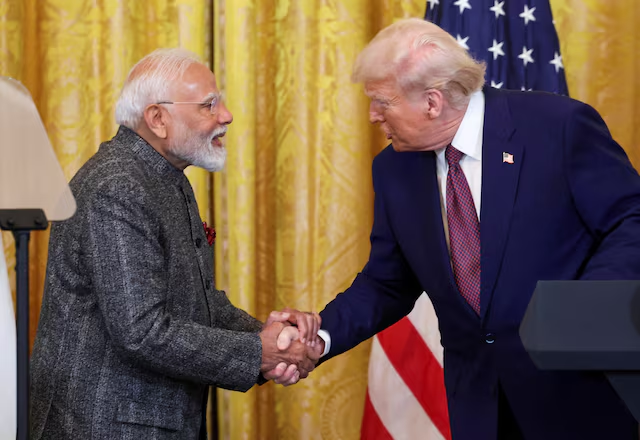
Russia could face a sharp fall in oil income if U.S. President Donald Trump succeeds in pushing India to halt purchases of Russian crude, analysts and traders said, because losing its biggest buyer of seaborne exports would likely force Moscow to offer steeper discounts to find alternative outlets, according to Reuters.
Trump said a new trade deal with India includes provisions for New Delhi to stop importing Russian oil, as Washington steps up pressure on Moscow to accept a peace deal in Ukraine. India has not publicly announced a halt, and refiners have continued to take Russian cargoes while taking a more cautious approach to new deals, traders said.
Trump India oil pressure and India’s buying stance
Trump has previously said Indian Prime Minister Narendra Modi agreed to stop buying Russian oil, but India did not halt imports, citing energy security and the need for cheaper supplies. The Kremlin has described energy cooperation with India as strong, and Russian officials have pointed to continued engagement after President Vladimir Putin visited India in December 2025.
Even so, market participants said the risk of tighter U.S. scrutiny and compliance concerns has already made Indian buyers more selective in recent months, adding to the uncertainty around future purchases.
Russian crude flows to India fall, OPEC share rises
India’s imports of Russian crude fell to 1.38 million barrels per day in December, down 22% from November and the lowest level since January 2023, based on calculations cited by Reuters. Russia’s share of India’s crude imports slipped to 27.4% while OPEC’s share rose to 53.2%.
The decline followed a peak of around 2 million barrels per day of Russian imports in June 2025, reflecting how quickly buying patterns can shift when sanctions risks rise and discounts change.
Limited alternatives if India reduces purchases further
Analysts said China is the only large-scale alternative market capable of absorbing major additional volumes of sanctioned crude, but it has limits. If India stopped buying, Russia would likely need to re-route barrels to China at lower prices, a process that would take time and could force Moscow to cut production and exports in the interim.
Russia has maintained exports by redirecting flows away from Europe to buyers including China, India and Turkey. Turkey has also trimmed purchases in recent months amid tougher Western sanctions, traders said, narrowing Russia’s options for quick reallocation.
Signs of strain: wider discounts, budget pressure and unsold cargoes
Analysts said pressure on Russia is rising as fewer buyers are willing to take on the risk of sanctioned cargoes and as discounts widen. Traders also pointed to a growing number of tankers carrying Russian oil waiting at anchor, a sign that sellers are finding it harder to place barrels promptly.
A government official cited by Reuters said Russian budget accounts show a deficit driven by a shortfall in energy revenues, underscoring the importance of export income for public finances.
April could bring another dip as Nayara refinery maintenance looms
Indian refiners have not been instructed by the government to stop buying Russian crude, but sources said any shift would require a wind-down period for cargos already arranged for March.
India’s imports could fall further in April when Nayara Energy, a major buyer of Russian crude, is expected to shut its 400,000 barrel-per-day refinery for about a month of maintenance, according to traders.
Traders said volumes beyond April will depend on the trajectory of Russia-Ukraine peace talks and the Indian government’s broader stance on Russian energy purchases.
Replacement barrels: Middle East seen as the most practical option
Trump said India could buy more U.S. and Venezuelan oil to replace Russian supplies, but analysts said U.S. crude is not a like-for-like substitute because of quality differences, and Venezuela’s export capacity is limited.
Market participants said crude from Saudi Arabia, the United Arab Emirates and Iraq is more likely to fill any near-term gap if India cuts Russian imports, though discounts on Russian barrels could still make them difficult for buyers to ignore.