
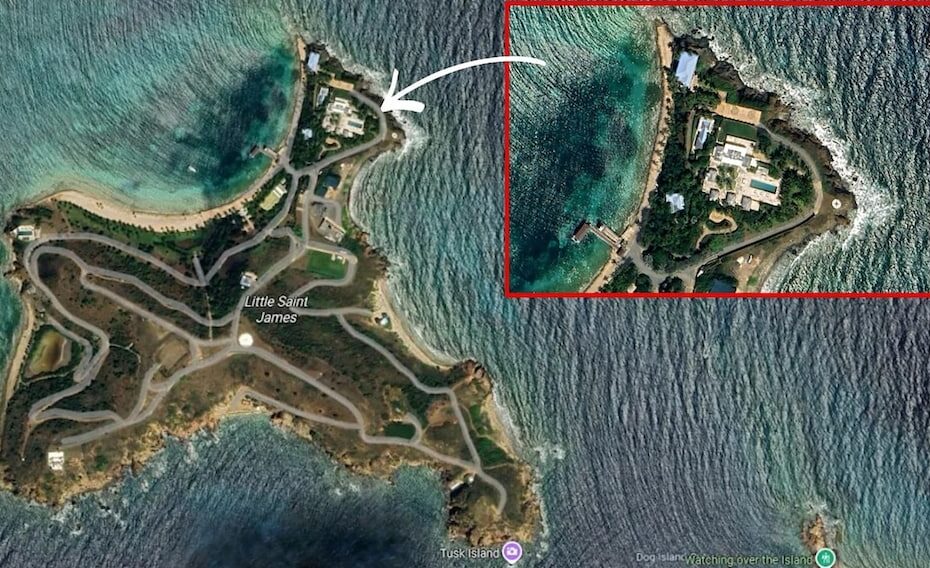
Nearly 3,000 kilometres from Washington, D.C., a small Caribbean island sits southeast of St Thomas, the capital of the U.S. Virgin Islands. From the air, Little St James looks like a private paradise. On the ground, its name is inseparable from disgraced financier Jeffrey Epstein and allegations of sexual abuse involving women and girls.
Little St James is a 72-acre private island. Aerial images show white-sand edges, palm cover, and a low hill with sweeping views. They also reveal clusters of buildings, at least one pool, and what appears to be a helipad. The same images, however, have come to symbolise something darker: a remote site tied to one of the most notorious sex-trafficking cases of the last decade.
Little St James, a luxury setting with a lasting stain
The island’s isolation helped to sell a fantasy of total escape. It also fed concerns about secrecy. Accounts cited in the text provided describe a place where access was controlled and unannounced visitors were discouraged.
That combination — wealth, privacy, and distance from oversight — is central to why Little St James has become shorthand for the case itself, even years after Epstein’s arrest and death.
How the island was built for privacy
According to the details in the text, Epstein bought Little St James in 1998 for an estimated US$8 million. It already had high-end infrastructure, including a main house, guest cottages, a dock, and a helipad. Support facilities were described as including staff accommodation and a desalination system, which turns seawater into fresh water.
By 2010, the island had reportedly been heavily redeveloped. The main villa was renovated and additional villas were built. A new pool was added, along with smaller stone cabins.
One building drew particular attention: a standalone, blue-and-white striped structure of roughly 3,500 square feet with an arched entrance. In reporting referenced in the text, building records described it as a “music pavilion”. Yet photographs and records were said to differ, fuelling speculation about its true purpose.
A helipad is a designated landing area for helicopters. On a small island with limited access, it can reduce reliance on boats and make arrivals and departures harder to track without clear records.
Images that intensified scrutiny
Photos described in the text, released by the U.S. House Oversight Committee in December of the previous year, showed a mix of large bedrooms, high-end living areas, and glossy bathrooms. Other images referenced included commercial-style kitchens, manicured lawns, and art stored in conditions that suggested neglect.
One object stood out: a yellow dentist’s chair. Its presence was described as unusual and has been the subject of dark speculation online. The photos themselves do not explain why it was there.
Who was said to visit — and what naming means
A central issue in the Epstein case has been the question of who moved in and out of his network. The text provided references massive file releases and lists of names circulating publicly.
It is essential to separate three things:
- being named in a document, email, or contact list
- being present at an event or location
- committing a crime
Mentions alone do not establish wrongdoing. Many people referenced in connection with Epstein have denied any improper conduct. Still, the scale of allegations and the power of some of the names have kept public attention fixed on Little St James.
Survivors’ accounts remain the core of the story
The most important voices in any account of Little St James are those of survivors. The text provided references memoirs and testimonies describing coercion, threats, and sexual violence, including accounts involving minors.
These allegations, and the broader criminal case, are why the island’s beauty cannot be separated from its history. For many, the name “Little St James” is not a destination. It is a reminder of harm and of failures by systems meant to protect vulnerable people.
Sold in 2023, with a resort plan on the horizon
The island’s future is now tied to its sale. In May 2023, Little St James and its larger neighbour, Great St James, were sold to U.S. financier Stephen Deckoff for US$60 million, according to NPR as cited in the text. That figure was reported as far below a previously listed price of US$125 million.
Deckoff, described as a resident of the U.S. Virgin Islands, said he wanted to transform the site into a “world-class” holiday destination.
The idea raises a difficult question: what does “moving on” look like for a place so closely linked to allegations of abuse? Any redevelopment will inevitably be judged not only by architectural plans, but by how it acknowledges what survivors say happened there — and by whether it avoids turning notoriety into marketing.
Little St James may still look like a tropical escape from above. Yet for the public, and for many victims, its identity has changed permanently. Any new chapter will be read through the shadow of the last one