
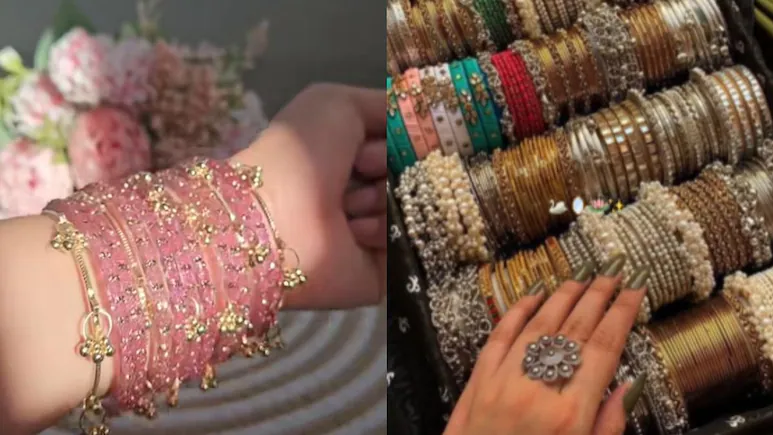
Indian bangles have started flooding Instagram feeds, from market hauls to styling clips that treat glass stacks as the finishing touch. The videos often point to budget bazaars and “steal price” bundles, with some reels nudging men to buy bangles for partners. The surge is not random. It tracks a wider pivot in online taste, where maximalist jewellery and familiar cultural cues now read as “aesthetic” rather than old-fashioned.
Why Indian bangles viral content is suddenly everywhere
The simplest explanation sits in how recommendation systems work. An algorithm is the set of rules a platform uses to predict what you will watch next, based on signals like viewing time, rewatches, saves, and shares. When a format performs well, the system tests it with more people. If it keeps performing, it spreads fast.
That dynamic helps explain why a niche jewellery reel can become a recurring feed pattern. It also explains why the content looks similar across accounts: close-ups of bangles sliding onto wrists, the audible clink, and quick cuts inside crowded markets. Creators often frame the trend as an “aesthetic shift,” moving away from quiet, pared-back styling.
From “clean” looks to loud jewellery you can hear
For much of the 2010s, minimalism dominated beauty and fashion content online. Many creators pushed restrained palettes and “clean” silhouettes. Now, creators increasingly reward the opposite: texture, shine, stacking, and movement.
Bangles fit that shift because they add sound and rhythm, not just colour. They also signal a look associated with South Asian weddings, festive dressing, and everyday femininity across generations. In reels, the sensory part matters. The clink becomes the hook that stops scrolling.
This change also matches what fashion media has been tracking in early 2026: online culture has leaned into throwbacks and bolder styling, with 2016 nostalgia surfacing as a visible trend.
Nostalgia economy and the comfort factor behind the trend
Creators often tie the bangle boom to the “nostalgia economy.” The term describes how brands and platforms profit from emotional attachment to the past, especially when audiences look for comfort and familiarity. In practice, nostalgia becomes a product feature: a sound, a colour, a ritual, a reference point.
Bangles carry that emotional weight for many South Asians. The image is ordinary and intimate: mothers, aunts, and grandmothers wearing bangles while cooking, cleaning, or getting ready. Reels that recreate that feeling do more than showcase jewellery. They package a memory as a shareable moment.
That helps explain why the trend resonates beyond India’s diaspora too. Viewers do not need the same childhood details to respond to the cues. The content still offers warmth, tradition, and a sense of “real life,” which plays well in a feed packed with polished minimalism.
A broader throwback wave is shaping 2026 feeds
The bangle trend has not appeared in isolation. In January 2026, major fashion coverage documented how “2016” itself became a viral reference point, with users posting throwbacks and style callbacks.
This throwback cycle creates space for other revivals too. On TikTok and Instagram, beauty creators have also pushed the “Bebot” makeup trend, a look that leans into glossy lips, shimmery lids, and sharply defined brows. “Y2K” also keeps returning in tutorials; the label refers to early-2000s fashion and beauty, often defined by shine, shimmer, and bold styling choices.
Together, these trends point to the same underlying logic: audiences respond to recognizable codes. Platforms notice. Then they amplify.
Indian markers are being recast as global style cues
Bangles are only one part of the current attention shift toward Indian aesthetics. Many reels celebrate details that Indian viewers have long considered everyday, such as henna patterns, anklets, and large earrings.
Some clips spotlight aalta, a red dye used in parts of South Asia to colour feet or hands during rituals and festive occasions. Others highlight jhumkas, bell-shaped earrings popular across the subcontinent, often worn in pairs that sway with movement. These cues translate well to short video because they are highly visual and instantly legible.
Creators also package these details as “heritage” styling rather than as costume. That reframing matters. It changes how younger audiences talk about the same objects. It also widens the audience, because the styling is presented as fashion-first, not region-locked.
What the market reels are really selling
Many bangle videos focus on where to buy them cheaply. That is partly practical, but it also drives engagement. Market content offers discovery, price comparison, and a sense of insider access. When a creator names a bazaar, films a vendor wall of colour, then shows a haul, the clip does three things at once: it entertains, it informs, and it invites saving for later.
The “steal price” framing also lowers the barrier to participation. A stack of bangles feels like an easy entry point into maximalism, compared with more expensive jewellery or designer accessories. That accessibility can help a trend scale quickly, especially when the platform rewards repeatable formats.
Why this matters beyond jewellery
The bangles wave reflects a larger cultural correction in how “traditional” Indian elements are valued online. For years, some styles were dismissed as too loud or too “massy.” Now those same cues are being reframed as intentional, stylish, and globally interesting.
This shift also lands at a moment when fashion and beauty cycles move faster than ever. Trends that once took seasons to spread now travel in days. In that environment, objects tied to memory and ritual can become viral content, provided the format is shareable and the styling feels current.
Indian bangles did not suddenly become relevant. The feed changed around them, and the internet’s taste followed. The clink that signalled everyday life in many homes now doubles as a soundbite for maximalist fashion—one that platforms can identify, package, and push to millions