
Graffiti has returned to Dhaka University’s walls, reviving the slogans and satire of the youth-led revolt that forced former prime minister Sheikh Hasina from office in August 2024 and opened the way to Bangladesh’s first broadly competitive national vote in years.
The election, scheduled for 12 February 2026, is being administered by an interim government headed by Nobel Peace Prize laureate Muhammad Yunus. For many first-time and younger voters, it will be their first experience of casting a ballot in a contest that is not dominated by a single ruling party.
Bangladesh election 2026 and a transformed political field
Bangladesh’s political landscape has been reshaped since Hasina’s fall. Her Awami League, which had governed for roughly 15 years and remained one of the country’s largest political forces, has been barred from contesting the election under decisions by the interim authorities and election administration reported by multiple outlets, including Reuters.
With the Awami League absent, the Bangladesh Nationalist Party (BNP) has moved into the centre of the race, with acting chairman Tarique Rahman widely described as the frontrunner after returning from years in exile. Islamist Jamaat-e-Islami is also seeking to expand its influence, including through alliances with newer parties linked to the student uprising that helped topple the former government.
Hasina’s exile and accountability for the 2024 crackdown
Hasina fled to India after resigning amid mass protests in August 2024. She has since been sentenced to death in absentia in Bangladesh in connection with the security crackdown during the unrest, according to reporting by Le Monde and assessments highlighted by Human Rights Watch.
A United Nations assessment cited by those reports put the death toll from the July–August 2024 violence at around 1,400, with most deaths attributed to security forces. Bangladesh’s interim officials have framed the forthcoming election as part of a wider political reset that includes accountability for abuses committed during Hasina’s final months in power.
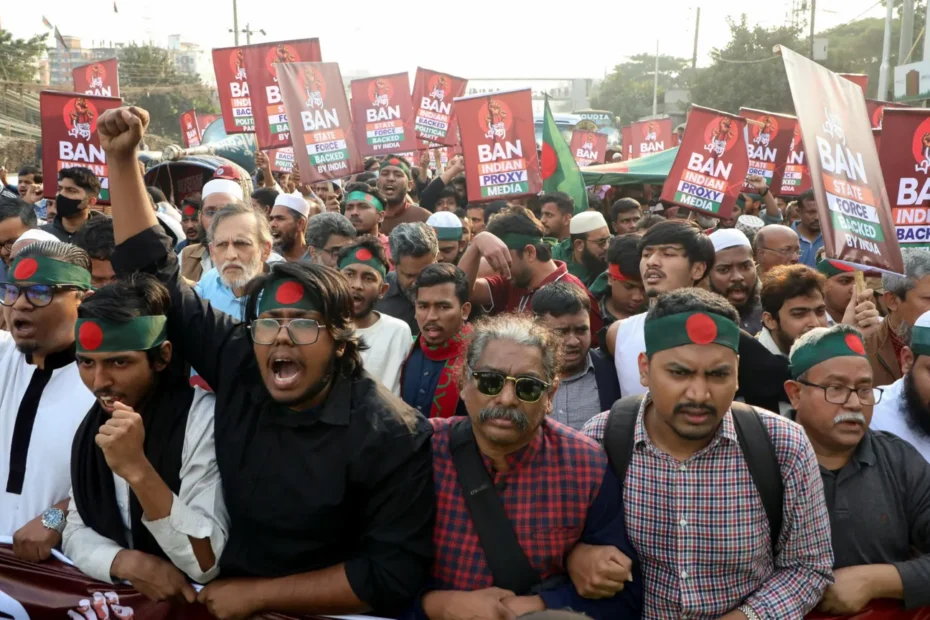
India has not agreed to return Hasina to Bangladesh, a stance that has become a central grievance for many activists and students who view her departure and subsequent protection abroad as a symbol of impunity.
“Dhaka, not Delhi”: anti-India sentiment goes mainstream
On campuses and in public spaces, anger is increasingly directed across the border. Slogans such as “Dhaka, not Delhi” have appeared in graffiti and political messaging, reflecting a broader belief among younger Bangladeshis that India enabled democratic backsliding by supporting disputed elections and maintaining close ties with Hasina’s government.
Analysts describe a widening gap between official diplomacy and public mood, with accusations in Bangladesh focusing on India’s political role as well as long-running bilateral disputes. These include border deaths, water-sharing negotiations over rivers shared by both countries, and trade frictions that critics in Dhaka say reinforce an unequal relationship.
The deterioration is also visible in day-to-day links. Both countries have curtailed visa services at various points, and cultural and commercial boycotts have been promoted by some groups in Bangladesh as the political climate has hardened.
New Delhi widens outreach as ties hit a low
India has moved to broaden contacts with Bangladesh’s major political actors beyond the Awami League. Indian External Affairs Minister S. Jaishankar travelled to Dhaka on 31 December 2025 to attend the funeral of former Bangladeshi prime minister Khaleda Zia and met BNP acting chairman Tarique Rahman during the visit, according to Indian and international reporting.
Contacts have also expanded to include Islamist actors, as New Delhi seeks to protect its interests regardless of who emerges from the vote. However, Bangladeshi officials and political figures say public distrust will be difficult to reverse quickly, especially while Hasina remains in India and while contentious issues such as border enforcement and river-water arrangements remain unresolved.
Bangladesh’s interim authorities have described the relationship as unavoidable given geography and economic ties, but they also acknowledge that public sentiment has shifted sharply since 2024, making any near-term diplomatic reset politically sensitive for whichever government takes office after 12 February.