
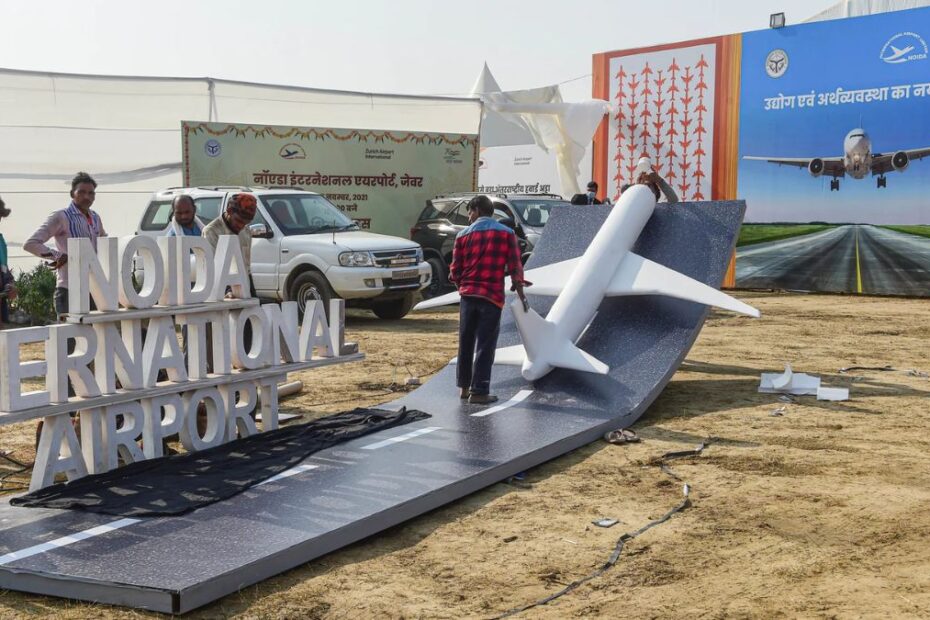
As India’s upcoming international airport in Jewar, Uttar Pradesh, took shape, thousands of local farmers gave up land and received compensation that, for many families, exceeded anything they had previously earned. In the years since, village streets have filled with new houses and new vehicles, and consumer goods that were once rare have become common.
But in the run-up to the airport’s expected inauguration, some residents say the initial surge of prosperity is fading for households that spent quickly and did not replace the steady income farming once provided.
Several families said they used compensation money to buy expensive phones and vehicles and to build larger homes, only to later struggle with routine costs. One resident said he could no longer afford repairs for a high-end phone bought after the payout. Another said his family now travels in a new SUV but often lacks cash for fuel.
Jewar airport payouts and land loss
The airport project required about 12,000 acres of farmland, local residents said, with compensation paid to affected landowners. For generations, farmland had been the core asset for many families, providing both food and regular income. Compensation replaced that asset with a one-time payment, which left households responsible for turning a lump sum into long-term security.
Residents described a rapid shift in consumption after payouts arrived. Farm machinery gave way to private cars, and many households moved money into construction, consumer electronics and weddings. Some said they later found themselves without a reliable income stream once savings diminished.
Two paths after compensation
In some parts of Jewar’s villages, compensation has been converted into businesses and income-producing assets. One landowner described investing in construction and running small enterprises alongside livestock, and said the family’s finances had strengthened as a result.
Elsewhere, residents spoke of the opposite outcome: savings depleted, fewer people working, and rising household stress. In one neighbourhood, residents said groups of men spent afternoons gambling in a local park. Several younger men said they were educated but had not pursued jobs after receiving compensation. Others cited problems including alcoholism, idleness and a sense of uncertainty about the future.
The contrast has created an increasingly visible divide inside communities that received similar payouts but made different financial decisions.
Compensation rates and fresh demands
Residents involved in the acquisition process said compensation amounts increased over time. In the first phase of land acquisition in 2018, farmers said they were offered about 20 lakh rupees per bigha, while later phases reached around 40 lakh per bigha.
Some landowners who sold earlier said they are now seeking additional compensation, arguing the initial amounts are no longer sufficient to sustain families without farmland and that later rates set a higher benchmark.
Limited safety net and calls for guidance
Residents and local officials said compensation was largely delivered without structured financial planning support. A local lawmaker said the state’s role is to provide compensation, while decisions on spending rest with recipients.
A financial expert interviewed locally said sudden wealth can push households toward high-cost purchases and urged greater outreach, such as counselling and awareness campaigns by local administrators, to help families plan for income, savings and reinvestment.
Development and the question of life after land
Jewar’s experience has become a reference point for the challenges that follow large-scale land acquisition. For some families, compensation has served as capital for new income and stability. For others, it has been a short-lived windfall that did not replace the security of farming.
With the airport nearing launch, residents say the key issue is no longer the size of the payout alone, but whether families can build sustainable livelihoods after land is gone.